
Post 12 of 29 in the AZ Hive series
You’ve loaded the frames. The alignment comb did its job and you pulled it back out. The frames are sitting on the rods, leading edges seated in the front-wall spacers. They’re aligned at the back too, but they’re still loose — you could slide any one of them out without resistance.
That’s where the inner door comes in.
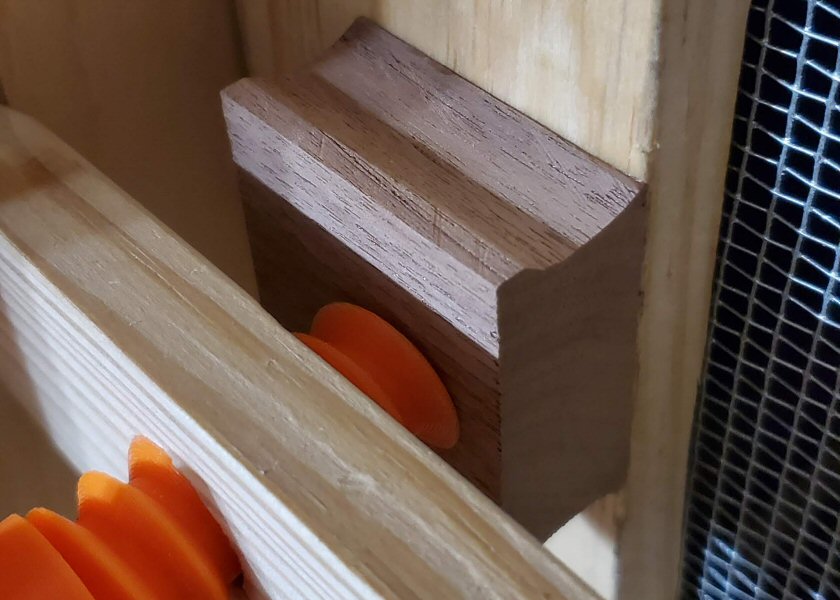
The inner door. A flat panel made from Home Depot’s discount-pile lumber (the kind with the purple paint stripe), with shiplapped ends so the boards lock together cleanly. The door fits the chamber opening and closes against the back ends of the frames. On the inner face of the door, two spacers line up with the back ends of the frames. They match the front-wall spacers in that chamber: 3D-printed plastic in the two brood chambers at the bottom (holding ten frames), metal screw-in spacers in the two honey supers at the top (holding nine frames). When the door is shut, the back spacers cradle the frame ends the same way the front-wall spacers cradle the leading edges. The center section of the door is screened with 1/8″ hardware cloth — enough to peek into the hive without letting bees out.
Now the back ends are held at proper spacing too. Two pairs of spacers, working together, keep every frame parallel and at consistent distance.
Why a separate locking bar? The door alone isn’t enough. With just the door, any movement could let it topple out and let the bees wander. The locking bar takes care of that.
After the door is closed, I slide the wooden locking bar into the nearest slots cut for it just behind the door. Two big 3D-printed screws on the bar — one near each end — tighten down against the walnut handles on the door, pushing the door forward and sandwiching the frames tight against the front-wall spacers. The screws have lag-bolt-style threads, and I built a custom thread tap in the shop to cut matching threads into the bar — so the screws spin in cleanly and hold under pressure. (The screws are also color-matched to each hive, part of a Scooby Doo theme that runs through the apiary. More on that later in the series.)
Result: the frames are sandwiched, end to end, between two sets of spacers. Nothing moves.
Why this matters. More than it might sound. The AZ design promises that you can work bees without lifting heavy supers, observe a colony without fully opening it, and move the whole assembly without rebuilding it on the other end. None of that works if the frames inside are loose. The locking bar is what lets you tilt, tip, jostle, and move the whole hive with confidence that nothing’s going to come unseated inside. Some AZ setups even ride in mobile trailers and trucks — where the locking bar matters even more.
When you inspect a frame, you back the screws off, pull the locking bar, open the door, and pull whichever frame you want. When you’re done, you put it back, close the door, slot the bar in, tighten the screws. A few extra steps compared to a Langstroth — and those extra steps are exactly what made it possible to skip the lifting in the first place.
Next: Inside a Four-Chamber Hive Body — the hardware that makes one cabinet do the work of multiple Langstroth boxes.
Leave a Reply