
Post 13 of 29 in the AZ Hive series
We’ve been zoomed in on the chamber: the rods, the spacers, the dividers, the inner door, the locking bar. Step back, and the chamber itself is just the inside of something bigger. Each hive body holds four of these chambers stacked vertically.
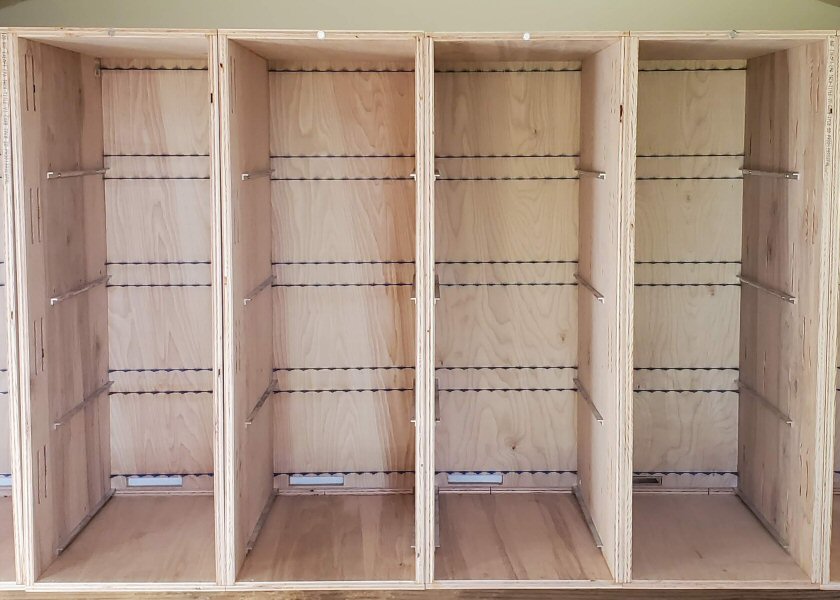
One 4×8 sheet of ¾” plywood per hive. That’s it for the body. One sheet. Cut, routed, and assembled into a four-chamber cabinet. The cut layout is planned to fit everything from a single panel, with a list of features built into each side wall:
- Slots routered for the inner-door locking bars (two sets of slots per chamber summer/winter).
- Holes and slots routered for the 3/8″ steel frame support rods (one hole, one slot per rod).
- Aluminum angle screwed in to support the chamber dividers.
- Saw slits for the 3D-printed front-wall spacers (not needed once weve upgraded to the screw-in metal version).
- Room for the slotted IPM trays at the bottom of each chamber.
- The bee-entrance penetration on the front-wall side.
Every one of those features is a small, deliberate cut. None of them are particularly hard on their own. Where the work shows is in getting them all in the right place at the right depth on the right side of the panel. A 1/16″ miss on a rod slot doesn’t break anything by itself, but stack four of those errors and the chamber stops being square.
The hive top also has a magnetic catch installed for the outer door — more on those next post.
All six hives. When everything is built and stacked, I have six four-chamber cabinets standing side by side. Each holding up to forty deep frames across four chambers — though in practice we run two brood chambers at 10 frames and two honey supers at 9 frames, for thirty-eight per hive.
Six hives. Twenty-four chambers. More than two hundred frames. Built from six sheets of plywood, plus all the small parts we’ve walked through over the last few posts.
It’s a different kind of operation than stacking Langstroth deeps in a row. The footprint is the same. The vertical reach is comparable. But every box you’d lift in a Langstroth setup is replaced by a chamber where the frame can pulled from the back. That’s the whole pitch.
Next post moves outside the chamber, to the outer doors that face the world.
Next: Outer Doors That Double as Chalkboards — plywood, chalkboard paint, and a quick-glance status system.
Leave a Reply