
Post 23 of 29 in the AZ Hive series
Five years in. Here’s what works and what doesn’t.
This is the post I wish I could have read before I started. The AZ design has real advantages over the Langstroth, but it also has trade-offs that aren’t obvious until you’ve lived with them for a couple of seasons. I’ll lay them both out honestly.
Advantages.
- Direct access to the brood chamber. No lifting supers off to get to the brood. Open the door, pull a frame, look at it. Saves a serious amount of work per inspection.
- Max lift: one frame. The whole point. A deep frame full of honey is about six pounds. That’s it.
- Hives never see under 40°F. Winter cluster stress is real, and our heated bee shed takes the worst of it off the table.
- Equipment kept together. Frames, tools, foundation, insulation, smoker fuel — all in one place, all within arm’s reach when you’re working a hive. In our case, the “smoker fuel” is just punk sticks, lit from a wall-mounted torch. The smoker itself is used mainly to blow air across the lit punk stick, forcing smoke through the inner doors.
- Can work bees in bad weather. Pouring rain outside? The shed is dry. The bees don’t fly when it’s raining, so there are more of them home in the hive than usual — but that’s part of the game, and I’m not getting soaked.
- Only one frame size. Every frame is a Langstroth deep. No mediums or shallows to keep track of. Standardization simplifies everything downstream.
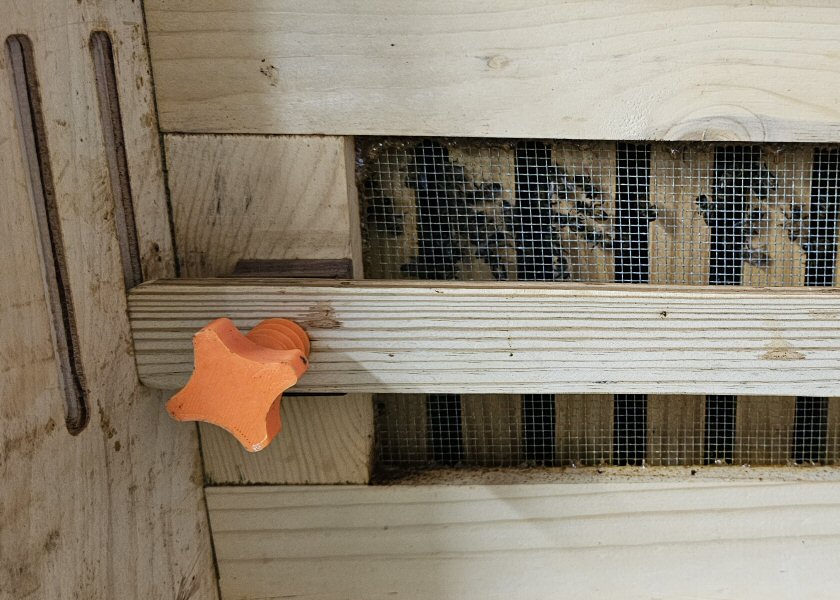
- Observe without opening up. The hardware-cloth window in the inner doors lets me check what’s happening in a chamber without breaking the seal.
- Easy to hear queens piping. Indoor acoustics. You can stand next to the hive and hear a new queen call out from a few feet away.
- Very little smoke needed. Calm bees, indoor environment, controlled airflow. A few puffs at the door with the punk stick is usually plenty.
- Easy to find a dropped queen. The Marching Board catches her on the way back in, and she’s easy to spot walking across a flat surface. If she misses the Marching Board, the floor is easier to see her on than grass outside — and if the shed door is closed, there’s no risk of her flying off.
- Bees tend to walk frames back into the hive. Set the frame on the Marching Board, and the bees naturally march home. Less brushing, less shaking.
Disadvantages.
- A bee can get trapped between doors. When you close the inner door with a stray bee in the gap, she’s stuck until you open it again. Mostly survivable but occasionally fatal.
- No scales. A scale under each hive lets you track weight gain in real time during a flow. The shed setup makes that physically impossible — the hives sit on a fixed structure and are fastened together for stability.
- Bee drift. Hives are close together inside the shed, and the entrances are a fixed width apart, so some drift between colonies is inevitable. Less than ideal for biosecurity and colony health. A bigger shed or fewer hives along the wall would resolve this.
- No boxes for frame storage. Langstroth boxes double as storage when not in use. AZ hives don’t, so I needed dedicated frame storage (the freezer, the under-desk shelf).
- Hard to find the queen if she’s not on a visible frame. In a Langstroth, if the queen isn’t on any visible frame as you place them into a second box, you can lift the box and easily see down into it. In an AZ, once all the frames are out and placed on the frame stand, looking back into the front of the hive is dark — and at just the right distance for my progressive lenses to be useless.
- Fixed at four chambers. A Langstroth grows by stacking more deeps. An AZ doesn’t. Once a colony fills the four chambers, your options are split, harvest, or swap out honey frames and place the full frames in the freezer.
- Splits to Langstroth nucs take longer. The AZ-to-Langstroth tab trick works, but it adds steps that Langstroth-to-Langstroth doesn’t have.
Five years in, the advantages outweigh the disadvantages for the way I keep bees. Your mileage will depend on your goals. If you’re chasing maximum honey yield with frequent expansion, the fixed four-chamber ceiling will frustrate you. If you’re optimizing for back-friendly, weather-independent, year-round-pleasant beekeeping, the AZ is hard to beat.
Next: Splitting an AZ Hive Into Langstroth Nucs — the tab trick that bridges between the two systems.