
Post 11 of 29 in the AZ Hive series
In the last post we walked through the frame. This one walks through the hardware that holds the frames in place inside the chamber.
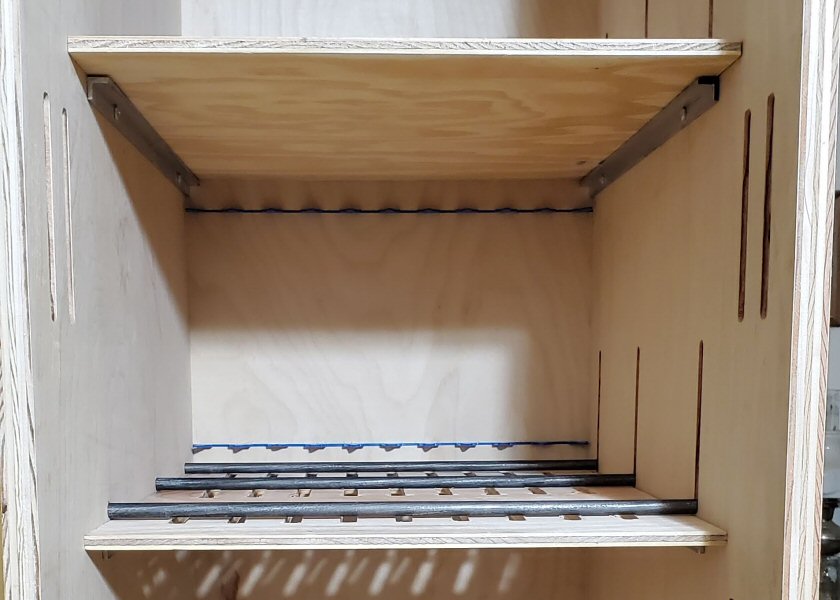
It’s not complicated. There are three small metal rods and four pieces of 3D-printed plastic. Together they turn a hollow plywood cabinet into a working bee chamber.
Aluminum angle supports. Every chamber starts with two ½” × ½” aluminum angles, one screwed to each side of the chamber. The chamber dividers rest on these.
Chamber dividers. Each chamber is separated from the ones above and below it. There are two divider styles:
- Solid chamber separator. A flat piece of material that closes the chamber off completely. Bees can’t pass through. Used at the top of a chamber when we want to confine the bees to fewer than four chambers.
- Slotted divider. Has openings cut in it. Bees can move between chambers, but the divider keeps them from building comb between the frames in adjacent chambers — which would make those frames a nightmare to remove.
The frame support rods. Three 3/8″ steel rods span the width of each chamber, parallel to one another, spaced evenly across the bottom. They sit in holes on one side of the hive and drop into slots on the other. Both the holes and the slots are ¼” deep. The rod goes in the hole first, then the other end falls into the slot — leaving no space between the rod and the divider board above. Once seated, the rod isn’t going anywhere unless you lift it. The frames rest on top of the rods.
Front-wall spacers. The leading edge of each frame slips into two spacers mounted on the front wall of the hive — the side the bees fly into. (The original ones are 3D-printed plastic; we’ve upgraded the honey supers to stainless steel.) In the honey supers — the top two chambers — the spacers hold frames at 9-frame spacing. Why 9 instead of 10? The extra room lets the bees overdraw the comb, which makes uncapping easier with a hot knife. The lower two brood chambers run 10 frames.
Lesson learned for the next build. On my current hives, the rod slots on the right are vertical only. The rod drops in under its own weight, but it doesn’t anchor anything else. On the next build, I’m going to add a small horizontal slot at the bottom of each rod slot, so the rod can be pushed sideways into the horizontal channel. That way the rod actually holds the divider down — turning the rod from a passive support into an active clamp. Small change, real quality-of-life improvement.
The 3D-printed alignment comb. Once all the frames are loaded in, the back ends still have a little play. Before I close the inner door, I drop a 3D-printed plastic comb over the back ends of the frames to push them into proper position. The comb is just a setup tool — once the frames are seated, I pull it back out, and the inner door’s own spacers take over and lock everything in place.
That’s the chamber: aluminum angles, dividers, rods, frames on top, spacers on the front wall. Bee space, gravity, and a few intentional details hold it all together. The inner door has its own pair of spacers, but those are in the next post.
Next: The Inner Door and Locking Bar — how the frames stay locked in place when you transport or open the hive.
Leave a Reply