
Post 8 of 29 in the AZ Hive series
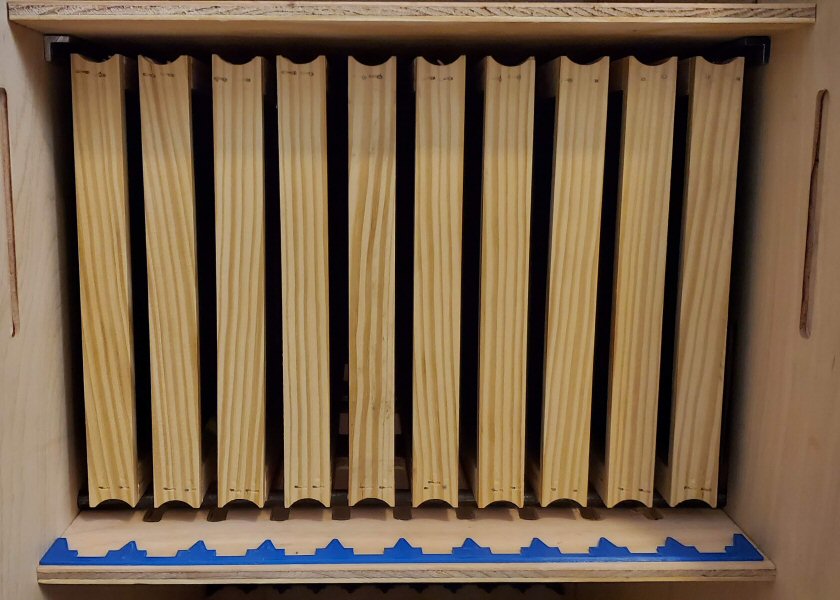
The bones of the design are the same. Rear-operated, frames load like books on a shelf, multiple chambers stacked vertically inside a cabinet. If you walked up to a traditional Slovenian AŽ and one of mine, you’d recognize the family resemblance. The differences are all in the details that come from where I live and how I want to use them.
The traditional AŽ is built into a bee house — a small wooden building, sometimes elaborate, with hives lining the interior walls with the whole hive face poking out through the wall. The bee house itself does a lot of work: it shades the hives, shelters the beekeeper from rain while inspecting, stores tools and equipment, and keeps the hive fronts protected. A traditional hive has an insulated front, two or three chambers, and two or three closable entrances per hive — one per chamber.
My version is built around a similar concept but with key changes:
- Four chambers, not two or three. More vertical room means more room for our honey flow.
- Uninsulated plywood body, not an insulated front. My hives sit inside a bee shed (more on that later in the series), so the shed wall does the insulating work. The hive itself doesn’t need to.
- One adjustable entrance per hive, not several. The entrance penetrates the insulated shed wall, much like an observation hive penetrates the wall of a building. Adjustable means I can size it for the season — wide open in summer, reduced in winter or during a robbing risk.
- Frames sized for Langstroth deep foundation, not the traditional AŽ size. The Slovenian standard is 10.25″ × 16″. Mine are 9.5″ × 17.625″ — same length as a Langstroth deep frame, 3/8″ taller, sized to use standard Langstroth deep foundation.
Each of those choices is a trade-off, not a strict improvement. A four-chamber hive means more frames to build and manage. A single entrance simplifies things, but one is all you need based on the feral-hive cut-out videos. Langstroth-sized frames mean I can move foundation and bees easily between AZ and Langstroth equipment, but it cost me the ability to buy AZ frames off the shelf. (There’s no shelf to buy them from in the U.S. anyway.)
Most of these decisions came from one underlying fact: I’m not in Slovenia. I’m building hives for a different climate, a different building, and a different supply chain.
The next several posts walk through what those decisions look like in practice — starting with the part of the hive that drove every other dimension.
Next: Anatomy of an AZ Frame — three-eighths-inch steel rods, identical top and bottom bars, and the foundation that decided everything else.
Leave a Reply