
Post 9 of 29 in the AZ Hive series
The first thing I drew was a frame.
Most off-the-shelf beekeeping starts with the box. But when building a box, the frame is what drives every other dimension. The cabinet is built around the frames; the frames aren’t built for the cabinet. So I started there and worked outward, using bee space to size everything else.
Here’s what makes an AZ frame different from a Langstroth frame.
No ears. A Langstroth frame has those little wooden tabs at the top corners — “ears” — that hang on the rabbet inside the box. AZ frames don’t have ears. The bottom bar of the frame rests on three 3/8″ steel rods that span the width of the chamber. The frame slides in lengthwise on the rods and locks into spacers on the front (side against the wall) of the hive.
Identical top and bottom bars. This is the trick that lets you do something a Langstroth frame can’t: flip a frame upside down. Top and bottom are interchangeable. You can rotate a frame end-for-end, or spin it 180° and reinstall it. That matters for managing honey and brood — you can move where the bees draw out wax, where they store, and where they raise brood, just by changing which way a frame is oriented.
Coved bars. The top and bottom bars are slightly hollowed on the contact surfaces, leaving less material touching the steel support rods. Two reasons: less contact reduces friction when sliding the frame in and out, and bees are less interested in propolizing the small contact patches that remain. (Propolis is the sticky resin bees use to seal gaps. It glues things shut. The less you give them to work with, the easier inspections are.)
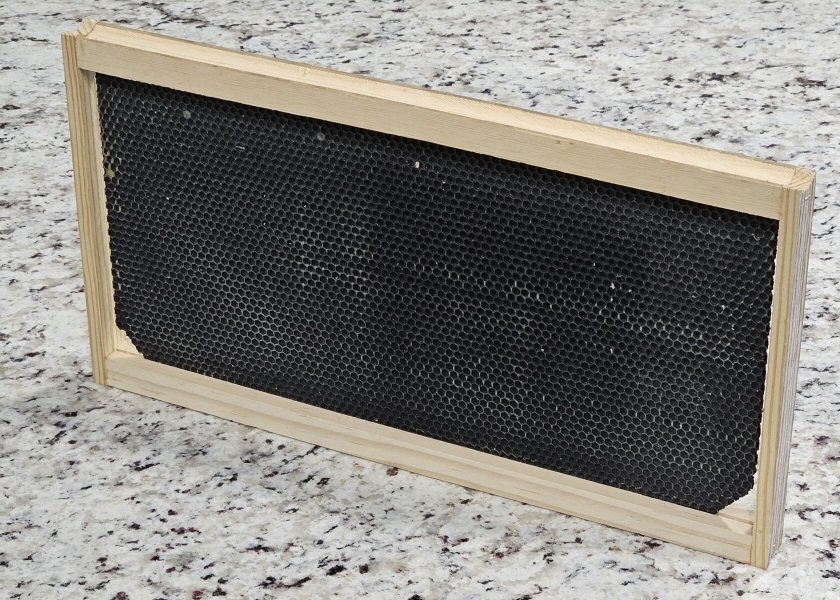
Langstroth deep foundation. Frame size and foundation go together. Mine are sized to take Mann Lake’s 8½” Waxed Rite-Cell foundation in black — SKU FN810. The Rite-Cell is a plastic foundation embossed with a hex-cell pattern and pre-coated with wax. Black helps when you’re inspecting for eggs and small larvae; light yellow eggs against black foundation are much easier to spot than against light wax.
The corner notch trick. When I cut foundation to size, I clip two corners and install the foundation with the notches at the bottom. Since AZ frames can be flipped, this gives me an instant visual cue for which end was originally “down” — useful when you’ve inverted half the frames in a chamber and want to keep track of which is which. Costs nothing, and saves a moment of mental rotation every inspection.
Next: The IPM Tray — what sits on the bottom floor of an AZ hive, and why it pulls out without a single bee escaping.
Leave a Reply