
Post 6 of 29 in the AZ Hive series
In winter, a colony of bees forms a tight cluster — basically a ball of bees vibrating their flight muscles to generate heat. The cluster doesn’t sit still. As the bees consume their honey stores, they slowly move toward the next reserve. How they do that depends on how the hive is laid out.
In a horizontal hive — Layens, long Langstroth, top bar — the frames sit side by side. To get from one frame to the next, the cluster has to move around the edge of a frame. In the dead of winter, that means a portion of the cluster ends up near the cold outer wall of the hive. They have to abandon warmth to get to food.
That can be partially fixed by orienting frames the other way — turning them so the cluster moves along the long axis instead of the short one. But it never stops being a horizontal problem. The cluster always has to spread sideways to reach the next stash.
In a vertical hive, the cluster moves up. Bees consume honey, the cluster shifts upward to where the next honey is, and the next, and the next. They stay in the middle of the hive the whole time. As a bonus, the warmth they give off rises directly into the honey above them, warming it and making it easier to access in cold weather.
That’s the case for vertical, and it’s a strong one in any climate that has a real winter.
But “vertical” usually means stacking deeps — which is the lifting problem I started with. So I needed a vertical hive that didn’t require lifting boxes off the top to inspect or harvest. That’s the AZ.
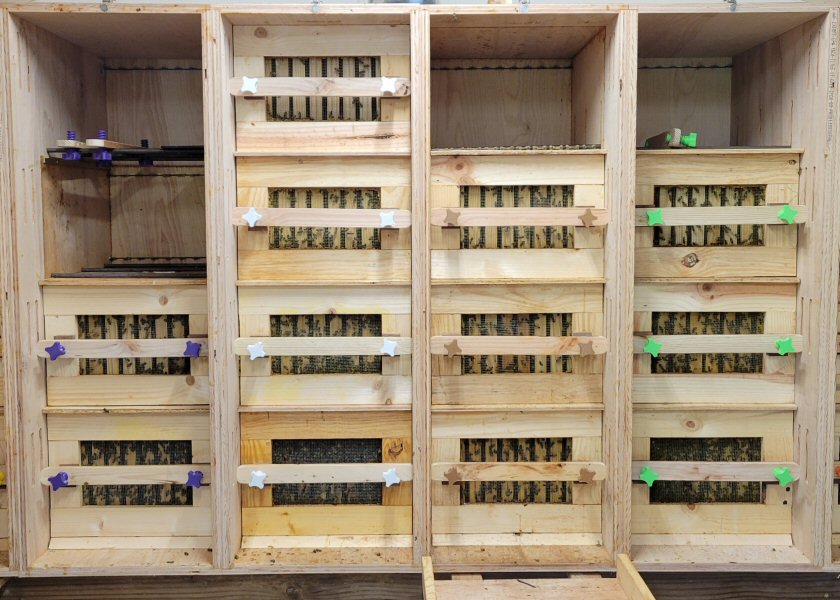
Looks a little like a kitchen cabinet, doesn’t it? Frames load in from the back, slide horizontally onto support rods, and stack vertically inside the cabinet. To work the bees, you open the rear doors, pull the frame you want, and put it back. No lifting. No stacking. Cluster stays in the middle, honey stays above.
There was one wrinkle. The traditional AZ frame is 10.25″ × 16″ — wider and shorter than a Langstroth deep at 9.125″ × 17.625″. Close, but not interchangeable. If I wanted to keep using Langstroth deep foundation — Mann Lake’s Rite-Cell is widely available, and standardization makes parts and splits a lot easier — I’d need to redesign the AZ frame around Langstroth deep dimensions.
Which a few American AZ builders had already done.
Decision made: vertical hive, AZ-style design, frames sized to Langstroth deep foundation.
Now I just had to build six of them.
Next: Meet the AZ Hive — a quick history lesson, because despite the name, it has nothing to do with Arizona.
Leave a Reply