Post 28 of 29 in the AZ Hive series
Six outer doors, one per hive. Each one covers the full stack of four chambers, so the doors are big — closer in size to a cabinet front than a small panel.
Here’s how they got built and finished.
The build. Each door is a single plywood panel cut to size. Thick enough to feel solid in the hand without being too heavy to lift on and off.
The finish, in order:
- Sand. Smooth the plywood face.
- Mask. We didn’t need the whole panel to be chalkboard. So we measured a straight line about a foot in from the top and bottom edges and taped off the center section, keeping a clean line.
- Metal primer. Iron-particle primer over the masked center, so magnets can stick to the door for status notes. Two coats for coverage.
- Chalkboard paint. Two coats over the primer. The center portion of the panel becomes a chalkboard surface.
- Trim. Border trim glued and brad-nailed at the top and bottom edges of the chalkboard paint. Makes a clean transition to the plywood — the tape edge on its own was ugly.
- Stain. The trim and the panel face above and below the chalkboard get stained. The natural wood color contrasts nicely with the dark chalkboard field.
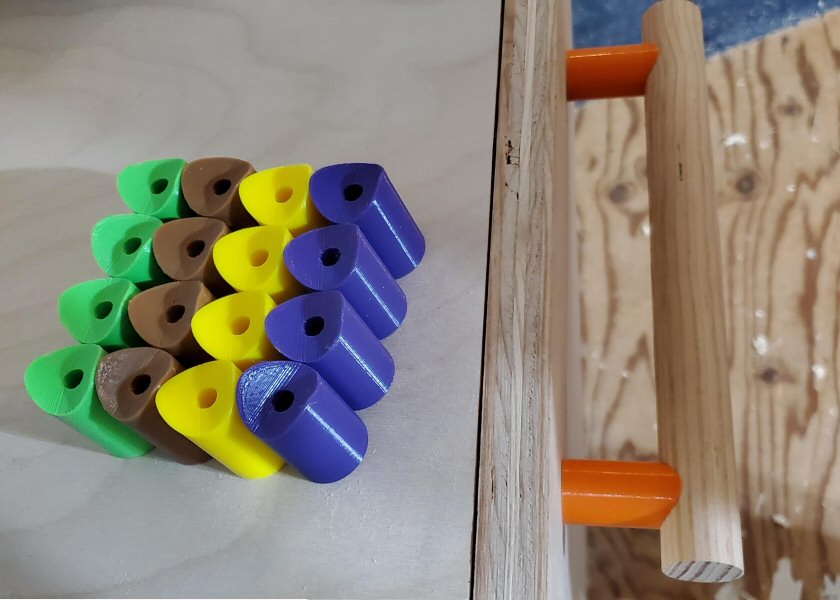
The hardware. Two wooden dowel rods, about the size of a closet hanger rod, cut a little shorter than the panel width and stained to match the rest of the wood. Each dowel cradles into a pair of plastic standoffs. A screw from the inside of the door goes through the standoff and into the dowel, sandwiching the standoff between the door and the dowel. The standoffs are color-matched to each hive’s Scooby Doo character.
At the bottom of the door, a small strip of wood is screwed to the interior face. Two alignment pins point down out of that strip and fit into matching holes in the hive base — the door self-positions when you set it in place. At the top, a magnetic catch built into the chamber edge holds the door temporarily until the latch is secured.
That’s the whole build. Cut, sand, mask, prime, paint, trim, stain, hardware. Six doors.
The outer doors are the visible face of the apiary. They take longer to build than the inner doors, mostly because of drying time between coats — actual hands-on time is modest.
With these in place, the hive bodies are complete.
Next: What I’d Change on the Next Build — five years in, the things I’d do differently if I were starting from scratch.